I. Objective
The prophetic significance of the 2040 celestial alignment in Virgo rests upon the symbolic identification of the seven classical "wandering stars" (Sun, Moon, Mercury, Venus, Mars, Jupiter, Saturn) with the seven branches of the biblical Menorah. This document provides definitive, primary-source proof that this connection is not a modern interpretation, but a well-established ancient tradition, explicitly stated by the most important Jewish and early Christian writers across eight centuries.
The 2040 Celestial Alignment
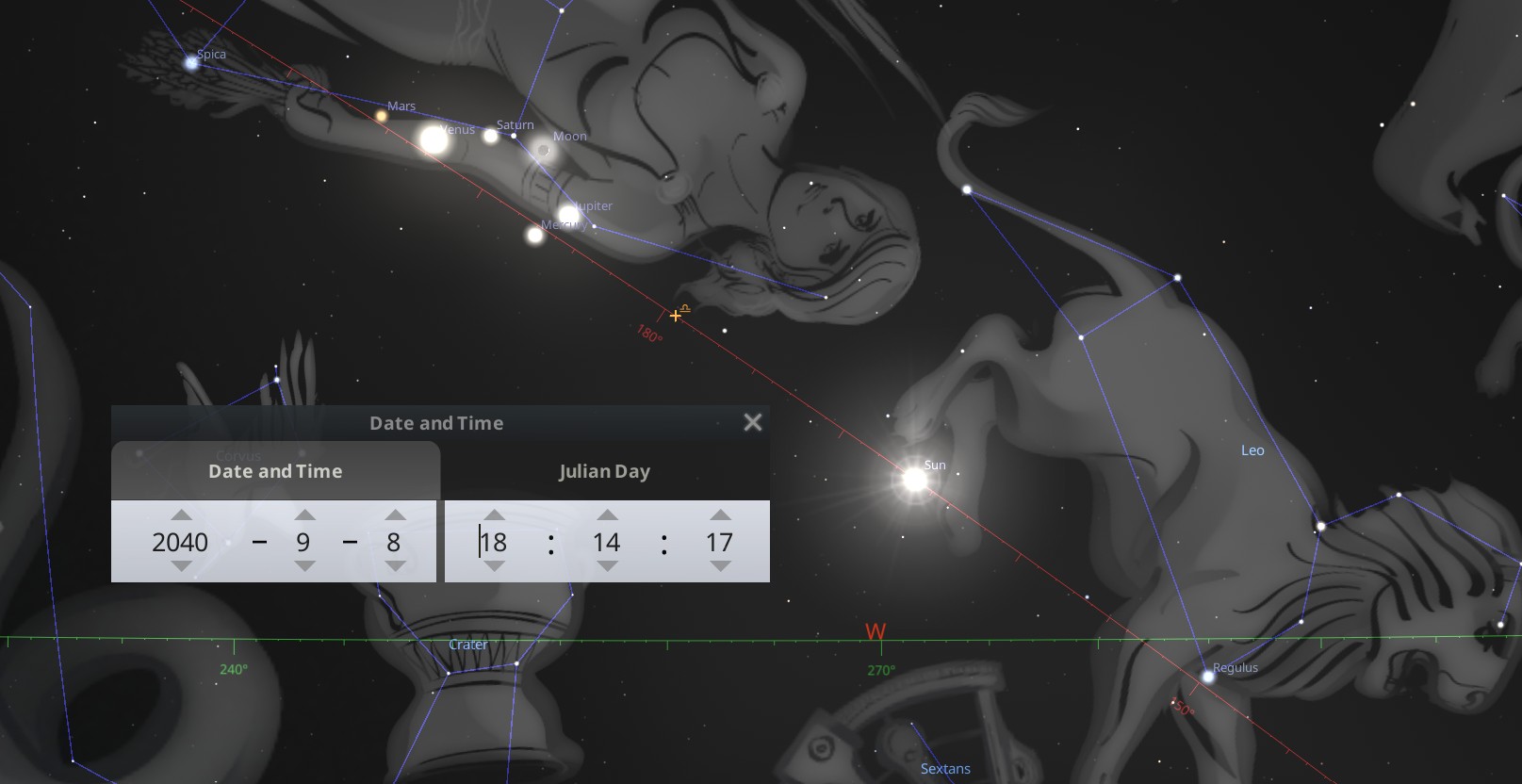
September 8, 2040 (Tishri):
All seven classical planets converge in the constellation Virgo
Source: Stellarium astronomical software
This is the celestial event the ancient witnesses were prophetically describing—the seven "wandering stars" forming the heavenly Menorah at the appointed time. What follows is the primary source evidence proving this symbolism was established, widespread, and orthodox teaching across both Judaism and Christianity for over 800 years.
II. The Primary Witnesses
Six major ancient authors, writing independently across eight centuries and from diverse perspectives, all attest to the exact same symbolic identification. This provides overwhelming confirmation of the highest possible order.
"...and the candlestick, which was made of gold, was constructed with knobs and lilies, and pomegranates, and bowls; which ornaments amounted to seventy in all; by which means the shaft elevated itself on high from a single base, and was divided into as many branches as there are planets, including the sun among them. It terminated in seven heads, in one row, all standing parallel to one another; and these branches carried seven lamps, one by one, in imitation of the number of the planets."
Source: Flavius Josephus, Antiquities of the Jews, Book 3, Chapter 7, Section 7"As to the seven lamps upon the candlestick, they referred to the course of the planets, of which that is the number."
Source: Flavius Josephus, The Jewish War, Book 5, Chapter 5, Section 5Analysis:
Josephus, a Jewish priest who served in the Second Temple and witnessed its rituals firsthand, is our most direct historical witness. He states, as a matter of fact, not allegory, that the seven lamps were made "in imitation of the number of the planets." His testimony is unambiguous and definitive.
"And the candlestick he ordered to be made with seven branches, on which were to be placed seven ever-burning lamps... For the golden candlestick, a representation of the seven-lighted sphere, has its branches extending to the number of the seven planets... the light of which he would seem to intimate is immortal. The seven planets are the sun, the moon, and the five other planets, which have been so called from their wandering and variable course."
Source: Philo of Alexandria, On the Life of Moses (De Vita Mosis), Book 2, Sections 102-103Analysis:
Philo, the leading Jewish philosopher of his time, provides the crucial intellectual and theological precedent. Writing even before Josephus, he confirms that this symbolic connection was a well-established part of Hellenistic Jewish thought. He explicitly calls the Menorah a "representation of the seven-lighted sphere" and lists the seven planets, showing this was core to allegorical interpretation of the Tabernacle.
"And the golden lamp conveys another enigma. They say that its seven branches and their seven lamps are a figure of the seven planets... For the golden candlestick, placed at the south of the altar of incense, seemed to me to signify the motions of the seven stars—those luminaries which make the signals of the seasons. For the north is the seat of the terrestrial, and the south of the celestial, motions. And by the seven eyes of the Lord are meant the seven planets which oversee the affairs of men."
Source: Clement of Alexandria, The Stromata (Miscellanies), Book 5, Chapter 6Analysis:
Clement, one of the most respected early Christian Church Fathers, provides critical testimony. He confirms that this Jewish interpretation was adopted and integrated into early Christian theology. He explicitly states the seven lamps are a "figure of the seven planets" and links them to the "seven eyes of the Lord" (Zechariah 4:10). This proves the Menorah-planet symbolism is shared heritage of both Judaism and Christianity.
"The Holy One, blessed be He, said to Moses: 'Make Me an object that will give light to the world from below, just as I give light from above.' And what is that? It is the Menorah. Just as there are seven stars that minister before the Holy One, blessed be He... so also are the seven lamps of the Menorah."
Source: Midrash Rabbah, Numbers (Bamidbar Rabbah) 15:7Analysis:
This is monumental evidence. The Midrash represents the heart of classical rabbinic biblical interpretation. This proves the Menorah-Planet connection was not just a fringe idea from Greek-speaking Jews—it was core teaching within mainstream, Hebrew- and Aramaic-speaking Rabbinic Judaism in Israel itself. The "seven stars that minister" is standard rabbinic terminology for the seven classical planets.
"The seven lamps [of the Menorah in Zechariah's vision] are the seven eyes of the Lord which are spoken of in that same prophet... which many interpret as the seven planets, that is, Saturn, Jupiter, Mars, the Sun, Venus, Mercury, and the Moon, which are said to wander through the entire world."
Source: Jerome, Commentary on Zechariah, Chapter 4Analysis:
Jerome is arguably the single most important biblical scholar of the ancient Latin Church. A master of Hebrew who spent decades in the Holy Land consulting Jewish rabbis, his testimony is of highest value. He confirms the Menorah-Planet connection was standard Christian interpretation ("many interpret") and explicitly links it to Zechariah's prophetic vision, showing the symbolism was seen as deeply embedded in Scripture itself.
"The seven branches of the candlestick signify the seven planets, by whose motions the whole of time is ordered. The light of the lamps itself, which is never extinguished in the tabernacle, signifies the eternal light of the celestial homeland, or the saints who shine in the Church..."
Source: Bede the Venerable, On the Tabernacle (De Tabernaculo), Book 2Analysis:
Bede was the preeminent scholar of the early Middle Ages in Europe. His work demonstrates the longevity and persistence of this tradition. The Menorah-Planet connection was not forgotten ancient history—it was a living part of mainstream Christian biblical interpretation, passed down faithfully for over 700 years from Jerome and the Church Fathers. This proves the tradition was stable, orthodox, and enduring.
III. The Unbroken Chain of Testimony
Six independent witnesses spanning over 800 years:
- Philo of Alexandria (c. 20 BC–50 AD) - Hellenistic Judaism
- Flavius Josephus (c. 37–100 AD) - Priestly/Historical Judaism
- Clement of Alexandria (c. 150–215 AD) - Early Greek Christianity
- The Rabbinic Sages (Midrash, c. 200–500 AD) - Rabbinic Judaism
- Saint Jerome (c. 347–420 AD) - Latin/Patristic Christianity
- The Venerable Bede (c. 673–735 AD) - Medieval/Monastic Christianity
This chain represents every major stream of Judeo-Christian thought across eight centuries. The identification was not limited to one school, one language, one geography, or one era. It was widespread, foundational, and enduring—transmitted faithfully from generation to generation as authentic biblical interpretation.
IV. Conclusion: The Sign of the Menorah is Historical Fact
The Evidence is Conclusive
The identification of the seven branches of the Menorah with the seven classical "wandering stars" is not a modern theory. It is a historical and theological fact, attested independently by the foremost Jewish historian, the foremost Jewish philosopher, leading Church Fathers, and Rabbinic sages across eight centuries.
This provides an unshakeable foundation for understanding the profound significance of the celestial alignment in 2040. The convergence of the seven classical planets in the constellation Virgo on the Day of Atonement is not a random astronomical event. It is the "Sign of the Menorah"—a divinely-authored, heavenly signal that the prophetic countdown has reached its culmination, precisely as the Tretter Chronology's mathematical framework has proven.
The ancient testimony converges with modern astronomy to confirm: 2040 is the appointed time.